
Laboratory Evaluation of Methylene Blue Degradation by Electro-Oxidation Using the YASA ET EO Test Kit
Mechanisms, Operating Parameters, and a Laboratory Demonstration Using
Methylene Blue, Sodium Sulfate, and anhydrous
YASA Environmental Technology Co., Ltd., No. 588 Xinjinqiao Road, Pudong, Shanghai, China
Corresponding author: info@yasa.ltd | www.yasa.ltd
Abstract
Electro-oxidation is an advanced electrochemical treatment process used to transform coloured and
refractory organic pollutants through direct anodic electron transfer and oxidation by electrochemically
generated species. This article reviews the principal reaction pathways, the function of dimensionally
stable anodes, the role of supporting electrolytes, and the operating variables that govern process
performance. These concepts are illustrated through a laboratory demonstration using the YASA
electro-oxidation test system. A 2 L synthetic wastewater sample prepared from tap water, methylene
blue, and anhydrous sodium sulfate was circulated through a reactor equipped with an iridium-based
oxide-coated titanium anode and a titanium cathode. After 30 min of direct-current treatment, the blue
colour was substantially reduced, and the solution appeared markedly clearer. The observation supports
disruption of the methylene-blue chromophore, but visual decolourisation alone does not establish
pollutant removal efficiency, complete degradation, or mineralisation. Quantitative evaluation should
therefore include UV–visible absorbance, chemical oxygen demand, total organic carbon, pH,
conductivity, applied charge, current efficiency, and specific energy consumption. The case study
demonstrates the value of laboratory screening while also showing why electro-oxidation systems
cannot be selected solely from wastewater flow rate or visual colour removal.
Keywords: electro-oxidation; anodic oxidation; methylene blue; dimensionally stable anode; iridium-coated
titanium; decolourisation; supporting electrolyte; wastewater treatment
Highlights
• Distinguishes direct anodic oxidation from mediated oxidation in the bulk liquid.
• Explains how electrode material, current density, conductivity, pH, temperature, and hydraulics affect
treatment.
• Presents a methylene-blue and sodium sulfate solution for demonstration using an iridium-based oxide-
coated titanium anode.
• Separates visible decolourisation from verified organic removal and mineralisation.
• Defines the minimum analytical data required for pilot and industrial scale-up.
1. Introduction
Industrial effluents from textile dyeing, printing, chemical manufacture, pharmaceuticals,
petrochemicals, landfill leachate management, and other sectors may contain coloured and poorly
biodegradable organic compounds. Conventional biological treatment can be ineffective when
pollutants are toxic, structurally stable, present at variable loading, or resistant to microbial conversion.
Electrochemical treatment offers an alternative in which oxidation and reduction reactions are driven by
electrical current rather than by the continuous bulk addition of oxidising chemicals.
Electro-oxidation is not a single reaction but a family of anodic processes. Pollutants may transfer
electrons directly at the anode surface, react with short-lived oxidants generated at or near the anode, or
be transformed by longer-lived mediators formed from species already present in the wastewater. The
dominant pathway depends on the electrode material and on the composition of the water matrix,
particularly chloride concentration, conductivity, pH, alkalinity, and organic loading.
This article is structured as a narrative technical review combined with a laboratory case study. It
first summarises the electrochemical mechanisms and operating parameters that control treatment,
then interprets a methylene-blue and sodium sulfate solution decolourisation test performed with the
YASA laboratory electro-oxidation system. The case study is intentionally treated as a screening
demonstration rather than as proof of complete pollutant mineralisation.
2. Scope and Review Framework
The review focuses on anodic electro-oxidation for organic-pollutant control, with emphasis on dye-
containing wastewater, mixed-metal-oxide or iridium-based titanium anodes, conductivity adjustment,
and reactor operating variables. Broader electrochemical technologies, such as electrocoagulation and
electrodialysis.
Its purpose is to place the laboratory observation within an accepted electrochemical framework and to
identify the data required before engineering design decisions can be made.
3. Fundamentals of Electro-Oxidation
3.1 Electrochemical reactor configuration
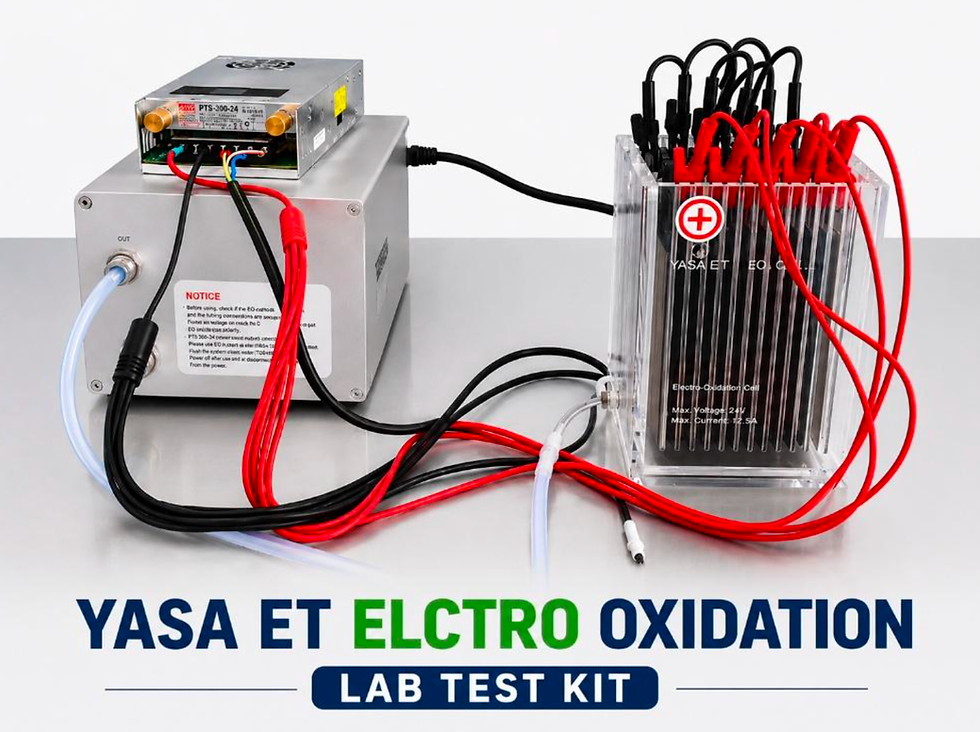
A basic electro-oxidation reactor contains an anode, a cathode, an electrolyte solution, a direct-
current power supply, and a hydraulic arrangement that brings contaminants into contact with the
electroactive region. Oxidation occurs at the anode, while reduction reactions occur at the cathode. In
flow-through or recirculating systems, pumping and mixing are used to limit concentration gradients and
improve the transport of pollutants and ions to the electrode surfaces.
3.2 Direct anodic oxidation
In direct anodic oxidation, a pollutant reaches the anode surface and undergoes electron transfer.
The initial transformation may break a chromophore, alter functional groups, or produce smaller
intermediates. Direct oxidation can be kinetically limited because only molecules transported to the
electrode surface can react. Electrode fouling, competing oxygen evolution, and mass transfer
limitations may further reduce the fraction of electrical charge used for pollutant conversion.
3.3 Indirect or mediated oxidation
In indirect oxidation, the applied current generates reactive species that subsequently attack
pollutants in the liquid phase. Depending on the anode and water chemistry, these may include surface-
bound hydroxyl species, active chlorine species, ozone, persulfate-related oxidants, or other mediators.
Where chloride is present, anodic chlorine formation followed by hydrolysis can produce hypochlorous
acid and hypochlorite. These species can accelerate colour removal, but they also create a requirement
to evaluate chlorinated intermediates, chlorate, perchlorate, and residual oxidant.
Representative anodic pathways
Water activation at the anode: M + H₂O → M(•OH) + H⁺ + e⁻
Chloride oxidation: 2Cl⁻ → Cl₂ + 2e⁻
Chlorine hydrolysis: Cl₂ + H₂O ⇌ HOCl + H⁺ + Cl⁻
These equations are schematic. Actual pathways depend on anode composition, potential, pH, and
wastewater chemistry.
3.4 Cathodic reactions and process consequences
Although pollutant destruction is normally associated with the anode, cathodic reactions affect
overall operation. Hydrogen evolution can generate bubbles, locally increase pH, and alter mixing. Metal
ions may precipitate near the cathode, while scaling can increase electrical resistance and block
hydraulic passages. Reactor design must therefore consider both electrodes, not only the anode
catalyst.
4. Electrode Materials and the Role of Iridium-Based Titanium Anodes
The anode largely determines oxygen-evolution behaviour, oxidant generation, service life, fouling
resistance, and energy demand. Titanium substrates coated with catalytic metal oxides are commonly
described as dimensionally stable anodes. The titanium provides mechanical strength and corrosion
resistance, while the catalytic coating provides an electrochemically active surface.
Iridium-based oxide coatings are frequently selected where robust oxygen evolution, electrical
conductivity, and long-term stability are required. In chloride-containing water, they can also support
the formation of active chlorine. This can be advantageous for rapid decolourisation and disinfection,
but it changes the treatment mechanism and may increase by-product risk. Consequently, an anode
should not be described as universally suitable without considering the wastewater matrix and the
target contaminants.
Electrode selection should be based on treatment objective, expected oxidant pathway, chloride
concentration, organic loading, allowable by-products, temperature, current density, and cleaning
strategy. Boron-doped diamond, lead dioxide, tin oxide, platinum-group-metal oxides, and mixed-metal-
oxide coatings exhibit different oxidation power, oxygen-evolution overpotential, cost, and durability. A
low electrode purchase price can be misleading if it produces poor current efficiency or short coating life.
5. Operating Parameters Governing Performance
Table 1. Principal operating parameters and their engineering significance.

6. Role of the Supporting Electrolyte
Electrical current passes through water by ionic movement. When the ionic strength is low, the solution
resistance increases, and the power supply must operate at a higher voltage to maintain the selected
current. A supporting electrolyte can reduce ohmic losses and stabilise current delivery. Sodium sulfate
is often used in laboratory studies because it increases conductivity without deliberately introducing
chloride as the dominant mediator.
In the present demonstration, anhydrous sodium sulfate served principally as a conductivity-
supporting salt rather than as the primary oxidising chemical. That distinction is important. The addition
of sodium sulfate does not by itself prove sulfate-radical generation under the stated conditions. Claims
of persulfate or sulfate-radical chemistry would require suitable electrode conditions and direct or
indirect evidence of those species.
In industrial wastewater, the need for added electrolyte should be determined from measured
conductivity and the resulting cell voltage. Wastewater already containing dissolved salts may not
require supplementation. Adding electrolytes without an energy balance may improve electrical
operation while worsening total dissolved solids, corrosion, or reuse limitations.
7. Laboratory Demonstration with Methylene Blue and Sodium Sulfate Anhydrous Solution
7.1 Test objective and materials
Methylene blue was selected as a visible model contaminant because its intense colour allows rapid
qualitative observation of chromophore disruption. The test solution was prepared from tap water,
methylene blue, and anhydrous sodium sulfate. The laboratory system used an iridium-based oxide-
coated titanium anode and a titanium cathode, with recirculation through the electrochemical reactor.

7.2 Experimental conditions
7.3 Visual observations
At the start of treatment, the methylene-blue solution was strongly and uniformly blue. During the
current application, the colour intensity progressively decreased. After the reported 30 min treatment
period, the liquid appeared substantially clearer than the untreated solution. The reactor operated with
visible gas evolution and recirculation, indicating active electrolysis and mass transfer within the cell.


7.4 Technical interpretation
The visible loss of blue colour is consistent with disruption of the chromophoric structure of
methylene blue. The result may arise from direct anodic oxidation, mediated oxidation, or a combination
of both. Because tap water can contain chloride, some contribution from active chlorine is plausible,
but it was not measured and should not be asserted as the confirmed dominant mechanism.
Colourless intermediates may remain after the chromophore is destroyed. The accurate conclusion
is therefore that the experiment demonstrated qualitative decolourisation and stable operation of the
laboratory system under the tested conditions.
8. Minimum Analytical Framework for Future Tests
A credible electro-oxidation study must connect water-quality change to electrical dose. Visual
photographs are useful for communication, but are not adequate for process design. At a minimum, future
tests should record the initial and final pollutant concentration, absorbance spectrum, COD, TOC, pH,
conductivity, temperature, current, voltage, electrode area, liquid volume, treatment time, and
recirculation flow rate.
9. Relevance to Industrial Wastewater Treatment
Electro-oxidation can be considered for wastewaters containing dyes, refractory COD, phenolic
compounds, pharmaceutical residues, odour-causing compounds, selected nitrogen species, and other
difficult-to-biodegrade contaminants. It may be used as a principal oxidation stage or as polishing after
biological, physical, or chemical treatment. Published experience also supports integration with
filtration, adsorption, electrocoagulation, membrane processes, and other advanced oxidation
technologies.
Real industrial wastewater is substantially more complex than the synthetic methylene-blue solution.
Suspended solids can block electrode gaps; oils and surfactants can foul surfaces; carbonate and
hardness can cause scaling; chloride can change both performance and by-product formation; and high
COD can increase the electrical dose required. Laboratory screening with actual wastewater is therefore
necessary before pilot design.
Equipment selection based only on flow rate is technically unsound. Required anode area, power-
supply capacity, residence time, recirculation rate, cooling requirement, and energy consumption
depend on pollutant loading and matrix chemistry.
10. Scale-Up, Safety, and Research Priorities
Scale-up should preserve relevant charge loading, current distribution, mass-transfer conditions,
and electrode-area-to-volume ratio rather than merely multiplying laboratory volume. Voltage losses
through larger hydraulic paths, gas disengagement, heat removal, electrical safety, electrode
replacement, and cleaning access become increasingly important at pilot and industrial scales.
The principal development priorities for the present test system are: quantitative pollutant and
COD/TOC analysis; controlled comparison of current densities; measurement of voltage and energy use;
tests with and without chloride; electrode-lifetime evaluation; identification of transformation products;
and validation using actual industrial wastewater. These steps would convert the current visual
demonstration into an engineering data set suitable for process optimisation and scale-up.
11. Conclusion
The YASA electro-oxidation laboratory test achieved rapid and effective decolourisation of a 2 L
methylene blue solution containing sodium sulfate. Using an iridium-based mixed-metal-oxide-coated
titanium anode and a titanium cathode, the visible blue colour was substantially eliminated within 30
minutes of treatment. This result demonstrates strong electrochemical oxidation activity and confirms
that the YASA test system can effectively disrupt the chromophoric structure of methylene blue under
the selected operating conditions.
The test, therefore, provides a successful proof of concept for the electro-oxidation process and confirms
The suitability of the YASA laboratory system for wastewater-treatment screening and process
optimisation.
Overall, the experiment produced a clearly positive treatment result and supports further optimisation of
operating parameters, followed by pilot-scale validation using actual wastewater.
If you have any doubts about cutting fluid and emulsion wastewater treatment, YASA ET experts have designed a wastewater treatment system for many factories.
To get in touch with our team:
🌐 www.yasa.ltd(EN)
🌐 www.yashahuanjing.cn (中文)
📱 +86 136 3643 1077
Visit the YASA ET official online store, click here

Comments