
EOXCell Electro-Oxidation Test Equipment for Water and Wastewater Treatment
A practical review supported by an EOXCell 1560 methylene blue demonstration
YASA Environmental Technology Co., Ltd., No. 588 Xinjinqiao Road, Pudong, Shanghai, China
Corresponding author: info@yasa.ltd | www.yasa.ltd
Abstract
Electro-oxidation is a flexible electrochemical process used to investigate the treatment of colored, refractory, odorous, and microbiologically contaminated water and wastewater. Its performance depends strongly on the electrochemical cell, electrode material, current density, electrolyte composition, pH, temperature, and contact time. This article reviews the practical role of electro-oxidation testing and presents a laboratory demonstration conducted with the YASA ET EOXCell 1560. The test used Ti/Ru-Ir coated titanium anodes, titanium cathodes, methylene blue as a visible model contaminant, and sodium sulfate as a supporting electrolyte. During the 28-minute run, the cell maintained stable voltage and current readings, showing that the equipment provided a controlled and convenient platform for electrochemical treatment trials. The experiment was designed as an operational demonstration rather than a validated removal study; quantitative treatment performance should be confirmed through sampling and analytical testing. The EOXCell platform is suitable for universities, research laboratories, environmental engineering companies, and industrial users that need reliable preliminary data before pilot- or full-scale process design.
Keywords: electro-oxidation; EOXCell; Ti/Ru-Ir anode; titanium cathode; methylene blue; wastewater treatability testing; electrochemical reactor
Key point: The EOXCell is not a black-box treatment claim. It is a controlled test platform that helps users determine whether electro-oxidation is suitable for their actual water before scale-up.
1. Introduction
Water and wastewater streams from textile production, chemical manufacturing, food processing, pharmaceuticals, metal finishing, and other industrial activities can contain compounds that are difficult to remove by conventional physical or biological treatment. Color may remain after clarification; dissolved organic compounds may resist biodegradation, and microorganisms or odor-causing substances may require an additional treatment barrier.
Electro-oxidation offers a practical approach for studying these problems. Instead of adding a fixed dose of an oxidizing chemical, the process uses an external electrical supply and an electrochemical cell to create oxidation conditions within the water. Because the reaction takes place at or near the electrode surface, the treatment can be adjusted by changing current, voltage, treatment time, electrode arrangement, or water chemistry.
The main limitation is that electro-oxidation cannot be selected reliably from COD or color data alone. Water conductivity, chloride and sulfate content, hardness, suspended solids, pH, temperature, and competing contaminants all affect the response. For that reason, laboratory testing is not an optional extra; it is the correct first step in developing an electrochemical treatment process.

2. Working Principle of Electro-Oxidation
An electro-oxidation cell contains at least one anode and one cathode connected to a direct-current power supply. Oxidation reactions occur at the anode, while reduction reactions occur at the cathode. Organic contaminants can be transformed through direct electron transfer at the anode surface or through oxidizing species generated electrochemically in the liquid.
The relative importance of direct and indirect oxidation depends on the electrode coating and the ions already present in the water. In chloride-containing water, active chlorine species may contribute strongly to oxidation and disinfection. In sulfate-containing water, sulfate primarily improves conductivity and may also influence the electrochemical reaction pathway. This chemistry is one reason the same equipment may perform differently on two wastewaters with similar initial COD.
The process is easy to start and stop, and electrical operating conditions can be changed during testing. This gives researchers and engineers direct control over the treatment intensity. However, a higher current is not automatically better. Excessive current may increase gas formation, heating, power consumption, and unwanted side reactions. The objective of testing is therefore to find a practical operating window rather than simply applying the maximum available power.

3. Why a Dedicated Test Cell Is Valuable
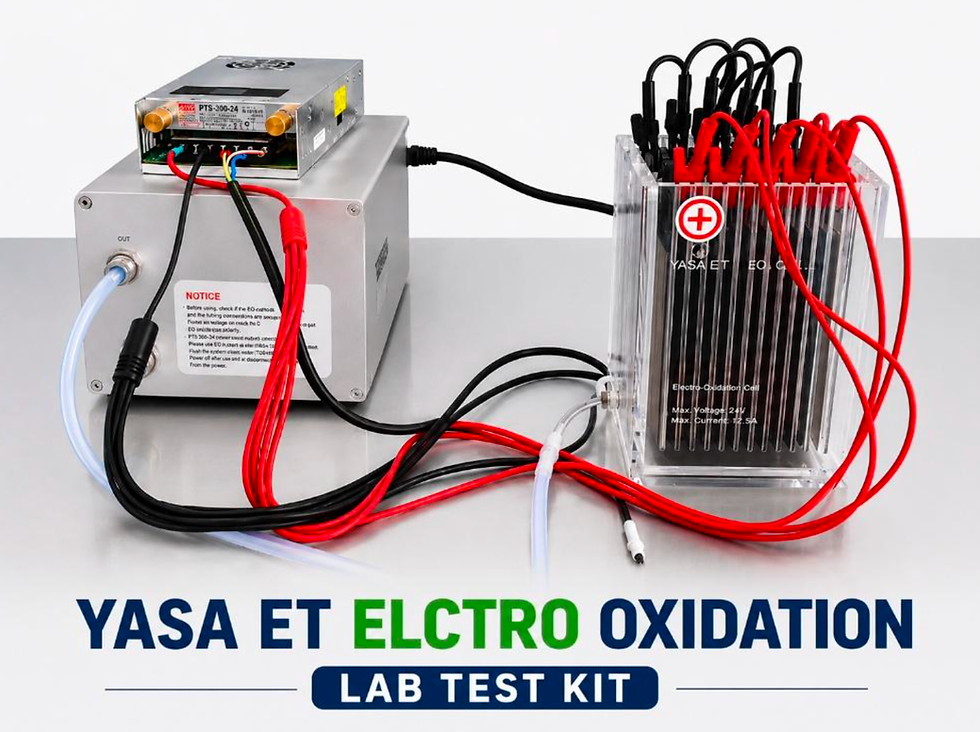
A useful test unit must do more than hold two electrodes in a container. It should provide a controlled electrode gap, repeatable plate arrangement, safe electrical connections, sufficient liquid contact, and convenient access for sampling and cleaning. These details matter because inconsistent cell geometry can make two experiments impossible to compare.
YASA ET developed the EOXCell series as part of its electrochemical test equipment range. The system is intended to help users examine the effect of cell configuration, electrode choice, electrolyte composition, current density, temperature, and treatment time before selecting larger equipment.
In practice, an EOXCell study can answer the questions that matter at the start of a project:
1. Does the wastewater respond to electrochemical oxidation?
2. Is the natural conductivity sufficient, or is a supporting electrolyte required? 3. How quickly do color, odor, or selected pollutants change?
4. Does the water produce excessive gas, foam, scale, or precipitate?
5. Which electrical operating range is stable and practical?
6. What analytical measurements are needed for pilot-scale design?
4. EOXCell 1560 Laboratory Demonstration
4.1 Objective
The purpose of the demonstration was to operate the EOXCell 1560 with a visible model solution and confirm stable electrical behavior under controlled laboratory conditions. Methylene blue was selected because its strong color makes it suitable for a clear visual demonstration. Sodium sulfate was used as the supporting electrolyte to provide the ionic conductivity required for current flow.
4.2 Equipment and Electrode Configuration
Item | Test information |
Test unit | EOXCell 1560 |
Operating mode | Laboratory batch demonstration |
Anode | Ti/Ru-Ir coated titanium |
Cathode | Titanium |
Individual plate dimensions | 65 × 120 × 1 mm |
Reported total electrode area | Approximately 1,940 cm² |
Electrode spacing | Approximately 1.5-2.0 mm |
Model contaminant | Methylene blue |
Supporting electrolyte | Sodium sulfate |
Test duration | 28 minutes |
4.3 Test Procedure
1. A water-based methylene-blue solution was prepared as the visible test medium.
2. Sodium sulfate was added as a supporting electrolyte and mixed into the solution.
3. The EOXCell 1560 was assembled with alternating Ti/Ru-Ir anodes and titanium cathodes.
4. The electrode plates were positioned with a gap of approximately 1.5-2.0 mm.
5. The cell was connected to a direct-current power supply, and the initial electrical readings were recorded.
6. The solution was treated for 28 minutes while the electrical behavior of the unit was observed.
7. Voltage and current were recorded again at the end of the run.

4.4 Recorded Operating Data
Operating point | Voltage | Current |
Beginning of test | 3.03 V | 2.46 A |
End of test | 3.01 V | 2.41 A |

5. Discussion of the Demonstration
The most useful observation from the test was the stability of the electrical readings. The voltage remained close to 3.0 V, and the current remained close to 2.4 A throughout the 28-minute run. This indicates that the prepared solution had adequate conductivity and that the cell operated without an obvious sudden increase in resistance.
From an equipment perspective, this is a positive result. A stable test cell makes it easier to compare operating conditions and to identify whether changes in treatment performance are caused by the wastewater or by an unstable electrical setup. The compact plate arrangement also provides a large contact area within a relatively small test volume, which is useful when only a limited wastewater sample is available.
The demonstration also confirms the practical role of sodium sulfate when the base solution does not have enough natural conductivity. A supporting electrolyte can reduce electrical resistance and help the unit maintain the selected current. In real wastewater, however, electrolyte addition should be minimized and assessed carefully because it increases dissolved salts in the treated water.
Published studies on methylene blue electro-oxidation show that electrode type, supporting electrolyte composition, current density, pH, initial dye concentration, and treatment time all affect the observed degradation rate. The EOXCell is useful precisely because these variables can be tested systematically rather than assumed.
6. What Should Be Measured in a Customer Treatability Test?
For a customer project, the electrical readings should be combined with water-quality data. A visually successful test may be persuasive during a demonstration, but engineering decisions require measurable results. The analytical plan should be selected according to the pollutant and the client’s treatment objective.
Recommended measurement | Purpose |
Color or UV-visible absorbance | Confirms and tracks decolorization. |
COD | Measures the change in chemically oxidizable material. |
TOC or DOC | Shows whether organic carbon is actually being removed or mineralized. |
Specific pollutant analysis | Confirms removal of the target compound rather than only a general water-quality change. |
pH and conductivity | Explain changes in electrical behavior and reaction conditions. |
Temperature | Identifies heating during longer or higher-current tests. |
Residual oxidants | Helps interpret continuing oxidation and protects downstream analysis. |
Toxicity or biodegradability | Useful when the objective is pretreatment before a biological process. |
7. Potential Applications
The EOXCell is intended for screening and process-development work. It can be used with synthetic solutions during teaching or research and with actual industrial wastewater during customer treatability studies. Potential applications include:
1. Textile and dyeing wastewater with persistent color;
2. Chemical and pharmaceutical wastewater containing refractory organics; 3. Food-processing wastewater requiring polishing or odor control;
4. Electrochemical disinfection studies;
5. Surfactant- and detergent-containing wastewater;
6. Pre-treatment before biological treatment;
7. Final polishing after conventional treatment;
8. University research on electrode behavior and electrochemical reaction conditions;
9. Comparison of electrical settings before pilot-scale testing.
8. Why the EOXCell Is a Strong Test Platform
The EOXCell is effective as a laboratory platform because it combines a structured electrochemical cell with practical operating flexibility. It allows the user to work with a small water volume, change test conditions, collect samples, and observe the system directly. This reduces uncertainty before larger equipment is selected.
1. Compact design suitable for laboratories and demonstrations;
2. Controlled and repeatable electrode spacing;
3. Stable plate arrangement and straightforward electrical connection;
4. Adjustable voltage, current, and treatment duration;
5. Small sample-volume requirement;
6. Easy access for sampling, inspection, and cleaning;
7. Suitable for comparative tests with actual wastewater;
8. Useful for academic research, customer demonstrations, and engineering scale-up studies; 9. Customizable according to electrode area, reactor volume, and project requirements.
Available EOXCell Models and Customization
YASA Environmental Technology can supply standard EOXCell configurations for different laboratory and research requirements. Available models include:
1. EOXCell 140
2. EOXCell 1240
3. EOXCell 3120
4. Custom-made EOXCell systems
Custom systems can be designed according to the required electrode size and number, active electrode area, reactor volume, electrode spacing, power-supply range, batch or circulation mode, sampling arrangement, instrumentation, wastewater characteristics, and research objective.
10. Conclusion
The EOXCell 1560 demonstration showed that a Ti/Ru-Ir anode and titanium cathode arrangement can be operated in a stable and convenient laboratory configuration. During the 28-minute test with methylene blue and sodium sulfate, the voltage and current remained nearly constant, confirming reliable electrical operation under the selected conditions.
The main value of the experiment was not a claimed removal percentage. Its value was demonstrating that the EOXCell provides a controlled platform for electrochemical testing. With proper sampling and analysis, the same equipment can be used to identify the required treatment time, electrical operating range, electrolyte need, pretreatment requirements, and scale-up basis for a real wastewater project.
For universities and research laboratories, the EOXCell offers a practical platform for electrochemical studies. For industrial users and environmental engineering companies, it offers a disciplined way to test wastewater before committing to pilot or full-scale equipment.
If you have any doubts about cutting fluid and emulsion wastewater treatment, YASA ET experts have designed a wastewater treatment system for many factories.
To get in touch with our team:
🌐 www.yasa.ltd(EN)
🌐 www.yashahuanjing.cn (中文)
📱 +86 136 3643 1077
Visit the YASA ET official online store. Click here

Comments