
Bipolar Membrane Electrodialysis for Conversion of 4% NaCl into HCl and NaOH: A Pilot-Scale Study
YASA Environmental Technology Co., Ltd.
No. 588, Xinjinqiao Road, Pudong, Shanghai, China
Email: info@yasa.ltd
Website: www.yasa.ltd
Abstract
This study presents the pilot-scale bipolar membrane electrodialysis conversion of a 4 wt.% sodium chloride solution into hydrochloric acid and sodium hydroxide. The experiment was carried out on a recirculating pilot system under a constant applied voltage of approximately 19.98 V. Online measurements of pH, conductivity, temperature, current, and cumulative energy consumption were recorded at about 20-second intervals for 80.7 minutes. In this test, the three monitored streams represented the salt, acid, and base compartments. The salt conductivity decreased sharply from 79.95 to 2.05 mS/cm, while the acid and base conductivities increased from 6.65 to 200.4 mS/cm and from 0.01 to 100.9 mS/cm, respectively. The acid pH declined from 0.97 to 0.00, confirming strong acid formation, whereas the base pH remained strongly alkaline and changed slightly from 11.68 to 11.89. The current initially increased to a maximum of 2.66 A and then gradually decreased as the salt stream became depleted, while cumulative energy consumption reached 0.05 kWh by the end of the run. The results confirm effective salt splitting and stable production of acid and base streams from 4% NaCl using pilot-scale bipolar membrane electrodialysis.
Keywords
Bipolar membrane electrodialysis, sodium chloride, hydrochloric acid, sodium hydroxide, salt splitting, pilot-scale study, acid-base generation.
Introduction
Bipolar membrane electrodialysis is an electro-membrane process in which a salt solution is converted into its corresponding acid and base products through the combined action of an electric field, ion-exchange membranes, and water dissociation at the bipolar membrane interface. In the sodium chloride system, chloride ions migrate toward the acid compartment to combine with generated hydrogen ions and form hydrochloric acid, while sodium ions migrate toward the base compartment to combine with generated hydroxide ions and form sodium hydroxide. Compared with conventional chemical routes, this process offers reagent reduction, controllable operation, and the possibility of integrating resource recovery with membrane-based separation. The present work evaluates the behavior of a pilot-scale system using a 4 wt.% sodium chloride feed and discusses the evolution of conductivity, pH, temperature, current, and energy consumption during the conversion process.
Materials and Methods
Feed Solution and Process Streams
The test was performed with a 4 wt.% sodium chloride solution circulated through the salt loop of the pilot-scale system. The monitored process streams corresponded to the salt loop, the acid loop, and the base loop. Accordingly, the recorded pH, conductivity, and temperature values were interpreted as salt-stream, acid-stream, and base-stream measurements.
Operating Conditions and Data Acquisition
The system was operated at an approximately constant stack voltage of 19.98 V. Measurements of conductivity, pH, temperature, current, and cumulative energy consumption were logged automatically over a total duration of 80.7 min. The average recording interval was about 20 s, providing a detailed time-resolved record of the run.
Selected Initial and Final Values
Parameter | Initial | Final | Observation |
Salt conductivity (mS/cm) | 79.95 | 2.05 | Strong decline due to salt depletion |
Acid conductivity (mS/cm) | 6.65 | 200.4 | Strong increase due to acid formation |
Base conductivity (mS/cm) | 0.01 | 100.9 | Strong increase due to base formation |
Acid pH | 0.97 | 0.00 | Decrease toward strong acidity |
Base pH | 11.68 | 11.89 | Remained strongly alkaline |
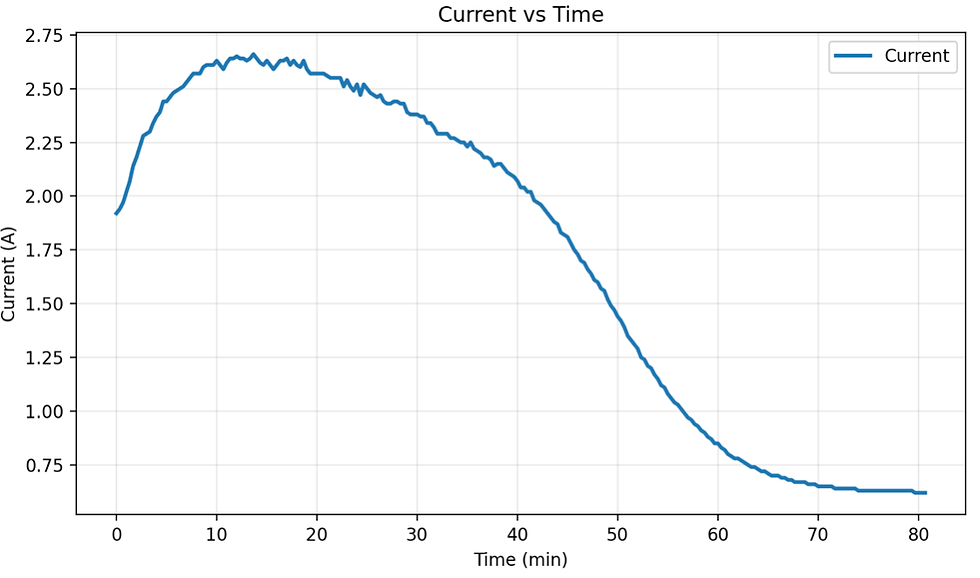
Current (A) | 1.92 | 0.62 | Peaked at 2.66 A then declined |
Energy consumption (kWh) | 0.00 | 0.05 | Cumulative increase throughout run |
Results and Discussion
1. Conductivity Profiles
The conductivity trends clearly demonstrate the salt-splitting performance of the system. The salt conductivity decreased continuously from 79.95 mS/cm at the beginning of the run to 2.05 mS/cm at the end, indicating progressive depletion of sodium chloride from the salt compartment. In contrast, the acid conductivity increased from 6.65 to 200.4 mS/cm, while the base conductivity increased from 0.01 to 100.9 mS/cm. These opposite trends confirm migration of chloride ions toward the acid compartment and sodium ions toward the base compartment, together with water dissociation in the bipolar membrane that supplied hydrogen and hydroxide ions for hydrochloric acid and sodium hydroxide generation. The rapid increase in acid and base conductivity during the first half of the run indicates efficient ion transport and product buildup, while the late-stage flattening reflects the approach toward a salt-depleted condition in the feed loop.

2. pH Profiles of Acid and Base Compartments
The pH behavior of the product compartments is fully consistent with bipolar membrane electrodialysis operation. The acid compartment pH decreased from 0.97 to 0.00, showing the buildup of a strongly acidic solution. The base compartment pH remained strongly alkaline throughout the test, varying only slightly from 11.68 to 11.89. This stable high pH indicates sustained formation and retention of hydroxide ions in the base loop. Together, these pH trends confirm the effective separation of acid and base products from the sodium chloride feed.

3. Temperature Profiles
The temperatures of the salt, acid, and base streams increased gradually over time, which is typical of membrane electrochemical systems operated under an applied electric field. The salt, acid, and base temperatures increased from 24.1, 22.8, and 23.6 °C to 28.2, 28.4, and 28.5 °C, respectively. The gradual rise is attributed mainly to Joule heating associated with ionic current passing through the membrane stack and circulating solutions. The relatively similar temperature trajectories across all three loops indicate stable hydraulic recirculation and good thermal balance during the pilot test.

4. Current vs Time
The current profile exhibited the characteristic behavior of a constant-voltage run. The current started at 1.92 A, increased to a maximum of 2.66 A as the membranes became fully conditioned and ion transport intensified, and then gradually declined to 0.62 A by the end of the experiment. The late-stage current decrease is explained by the depletion of sodium chloride in the salt compartment, which increases the electrical resistance of the system and limits further charge transport. The current trajectory therefore provides additional evidence that the run progressed from an ion-rich stage to a transport-limited stage.
5. Energy Consumption vs Time
The cumulative energy consumption increased continuously from 0.00 to 0.05 kWh over the full run. This monotonic trend is expected because the power supply continuously delivered electrical energy to drive ion migration and water dissociation. The slope of the energy-consumption curve is steeper during the period of higher current and becomes slightly gentler as the current falls in the later stages, although the cumulative value continues to rise throughout the experiment.

6. Current vs Energy Consumption
The current-versus-energy plot provides a compact representation of the operational evolution of the system. At lower cumulative energy input, the current rises rapidly to its peak, reflecting efficient early-stage ion transport. As the process proceeds and more energy is consumed, the current declines because the salt stream becomes progressively depleted and the effective electrical resistance of the stack increases. This plot therefore illustrates the transition from the productive high-transport region to the late-stage depletion-controlled region.

Conclusion
The pilot-scale test successfully demonstrated the conversion of 4% sodium chloride into separated acid and base streams. The salt compartment showed marked depletion, with conductivity decreasing from 79.95 to 2.05 mS/cm, while the acid and base compartments showed strong enrichment, with conductivity increasing to 200.4 and 100.9 mS/cm, respectively. The acid pH decreased from 0.97 to 0.00, and the base pH remained strongly alkaline around 11.89, confirming stable acid and base generation. The current profile, which peaked at 2.66 A and ended at 0.62 A, together with the cumulative energy increase to 0.05 kWh, reflected the normal transition from high ion-availability to a salt-depleted stage. Overall, the data confirm that the pilot system effectively separated acid and base from a 4% sodium chloride solution and operated stably and predictably throughout the test.


Comments